|
||||||||
|
MennoPIN November 2018 Monthly Update
In This Issue
Kairos Palestine Christmas Alert
Is the U.S./Mexico Border Becoming Another Gaza?
Gaza on Fire
Airbnb Leaves West Bank Settlements
Trump Administration Threatens to Redefine Anti-Semitism
MCC Signs New Statement on Israel/Palestine
Careful What You Buy This Christmas!
Kumi Now!
Read More
Prayer
Kairos Palestine Christmas Alert

Kairos Palestine has just issued its Christmas Alert 2018. This year the Christmas Alert sheds light on the importance of restoring a new hope for Palestine, the Middle East and the world. The alert offers resources and reflections for each Sunday of Advent and inspires individuals and congregations to act to help make hope a reality in the lives of Palestinians.
Is the U.S./Mexico Border Becoming Another Gaza?

Fences and barbed wire. Tear gas and choking. Heavily armed border patrols and U.S. Army forces on one side of the fence. Desperate poverty and nonviolent presence of refugees on the other side, simply seeking a safer and better life. All very much like Gaza. Thankfully, no deaths so far, but President Trump has given the freedom to use lethal force.
On Sunday, November 25, 2018, as many of the refugees in the migrant caravan pushed to breach the border, U.S. forces, without warning, launched tear gas canisters on unexpecting refugees and would-be immigrants, including many children. The Chemical Weapons Convention of 1993, of which the United States is a part, has banned the use of tear gas on the battle field, but the U.S. has consistently used tear gas on domestic populations to control crowds, like Ferguson, Missouri. Under both the Obama and Trump administrations, tear gas has been used on refugees at the U.S./Mexico border.
The aerosol chemical compound, containing 2-chlorobenzaldene malononitrile, causes nasal passages to run, eyes to uncontrollably water and breathing becomes short and painful with a burning sensation in the throat and nasal passages. It is especially dangerous for children who do not know to close their eyes and shut their mouths. As Robini Haar, a doctor with Physicians for Human Rights, explained about children and tear gas: “Most kids scream for their parents when they are in danger. That natural, reasonable reaction to pain is detrimental in this case.” She went on to say that tear gas has harmful effects on children in both the short-term and long-term.
One refugee, Maria Meza (pictured above with her three daughters) described their experience afterward (translated): “I grabbed my daughters and started running. At that moment, I thought I was going to die with them. We ran and we fell into the mud and struggled to get up amidst the gas…We never thought they were going to fire these bombs where there were children…It wasn’t right. They know we are human beings, the same as them. It wasn’t right that they did that to the children.”
Trump’s response to the tear gassing: “Well, I do say, why are they there? I mean, I have to start off—first of all, the tear gas was a very minor form of the tear gas itself. It’s very safe…But you really say, ‘Why is a parent running into an area where the tear gas is forming and it’s going to be formed, and they’re running up with a child.’”
Just a few days before the tear gas attack, a jury found Border Patrol agent Lonnie Swartz not guilty of involuntary manslaughter in the shooting death of a 16-year-old boy, Jose Antonio Elena Rodriguez in 2012, firing nearly a dozen bullets through a U.S./Mexico border fence. All but one of the bullets were in the boy’s back. It was Swartz’s second acquittal, the first time for murder. The boy’s crime: throwing a rock.
Gaza on Fire

On November 12-13, 2018 Gaza exploded for the third time in just a few years. After a botched incursion into Gaza by Israeli commandoes on the morning of November 12, Hamas (the governing authority in Gaza with both a social service and military component) begin exchanging missiles with Israel. Israel used aircraft fire, missiles and drones to bomb targets in Gaza while Hamas sent hundreds of missiles into southern Israeli city of Ashkelon. At least 12 Palestinians were killed and numerous people in Gaza and Ashkelon suffered wounds.
A MennoPIN contact within Gaza took the photo above on a cell phone and wrote this on November 12 amid falling Israeli bombs: “Israeli warplanes continue shelling areas in the Gaza Strip. The shelling lasted for many hours, targeting sites, houses and a news channel, and resulted in a number of martyrs and wounded. Explosions were heard all over the strip.” The next day, he wrote that “Israeli forces have completely destroyed six buildings in Gaza so far today,” including family homes, a television station and a hotel.
Fortunately, an earlier-planned, Egypt-brokered cease fire ended the hostilities by the end of the second day. The terms of the cease fire included expanding fishing rights to Gazans, provision of fuel, and money from Qatar to pay Hamas and many civil workers. While some have wondered if Israeli Prime Minister, Benjamin Netanyahu, was turning a new leaf as a peacemaker, the truth probably lies elsewhere. By helping to keep Hamas in power in Gaza, Netanyahu keeps the two ruling factions in Palestine (the Palestinian Authority in the West Bank and Hamas in Gaza) divided, not just geographically, but also ideologically, lessening the ability of a united Palestine to apply effective pressure on his government. Amidst the power struggles, the people of Gaza continue to endure debilitating hardship after hardship.
Airbnb Leaves West Bank Settlements

A photograph taken last year from the Palestinian West Bank village Turmus Ayya shows the Jewish settlement, Shilo, where Airbnb had listings (Credit: Jaafar Ashtiyeh/Agence France-Presse — Getty Images)
In a victory for the BDS (Boycott, Divestment, Sanctions) movement and those working for justice in Palestine, Airbnb agreed to pull its listings out of the illegal Israeli settlements in occupied areas in Palestine. But their boycott is selective and applies to the West Bank but excluded East Jerusalem. A similar company, Booking.com, has not deleted its West Bank listings.
Airbnb’s press release states in part: “U.S. law permits companies like Airbnb to engage in business in [occupied] territories. At the same time, many in the global community have stated that companies should not do business here because they believe companies should not profit on lands where people have been displaced…When we applied our decision-making framework, we concluded that we should remove listings in Israeli settlements in the occupied West Bank.”
In response to Airbnb’s action,Israeli government officials and its supporters have responded with condemnation and threats. Minister of Strategic Affairs, Gilad Erdan denounced Airbnb’s withdrawal as a “racist political stance.” Minister of Tourism, Yariv Levin, termed the decision as “the most wretched of wretched capitulations to the boycott efforts.” The pro-Israeli NGO, Jewish Human Rights, called it “anti-Semitism pure and simple” and called for a boycott of Airbnb. BDS is working.
Trump Administration Threats to Redefine Anti-Semitism
Anti-Semitism is a serious problem in the United States. As defined by the Webster Dictionary, anti-Semitism involves: “hostility toward or discrimination against Jews as a religious, ethnic, or radical group.” Hate and prejudice against Jewish people has no place in our society whether as individuals, in government or in institutions (educational, religious or economic). MennoPIN stands firmly opposed to any expressions of anti-Semitism.
But the Trump Administration wants to take the definition of anti-Semitism one dangerous step forward. Kenneth Marcus is the Assistant Secretary of Education for Civil Rights. Marcus has proposed expanding the legal definition of anti-Semitism to equate criticism of the government of Israel with anti-Semitism. Entitled the “Anti-Semitism Awareness Act,” the proposed expanded definition has already produced a chilling effect on university campuses where, for example, a student or student group criticizing the demolition of Palestinian homes or killing of nonviolent Gaza protestors by Israel could be viewed as a violation of the act. Free speech on our campuses needs to be protected.
MCC Signs New Statement on Israel/Palestine
Mennonite Central Committee (MCC) is one of sixteen church-related organizations to sign a statement entitled, “Current U.S. Policy, Israel/Palestine, and the Churches.” The statement reads, in part:
“The current situation in the Occupied Palestinian Territories for most of the inhabitants is one of shattered hopes. Since President Trump took office in 2017, U.S. support for Israel over the concerns of Palestinians has become explicit instead of implied. As leaders of U.S.-based churches and Christian organizations with long ties and close connections with Palestinian Christians and churches, we are deeply concerned about these developments… As Christian churches and organizations in the United States, we strongly oppose this treatment of Palestinians. Most Palestinians have been peacefully protesting for 70 years in the hopes of gaining international recognition and their own state. We call on people of all faiths to stand up in support of human rights for both Palestinians and Israelis, including the right to self-determination.” To read the entire statement, click here.
Careful What You Buy This Christmas!

Kumi Now

The Sabeel Theological Education Center in East Jerusalem has created a bold new initiative to challenge the Israeli occupation of Palestine. In the face of overwhelming oppression and ineffective support from the international community, Sabeel “feels that giving up as a people on the margins is not an option.” Kumi Now (Rise Up) has just been launched and is inviting individuals, congregations, and local and international organizations to join the Kumi Now project to work as a united force for justice for Palestine.
Kumi Now is based on Mark 5:21-43 about two healing miracles, Jairus’ daughter and the woman with a hemorrhage. To Jairus’ daughter, Jesus says, Talitha Kumi, rise up! Just as the two were liberated from their suffering, so, too, says Sabeel, “We hear Jesus’ command to rise up in our own context…we say now is the time for action. This is why we are launching the Kumi Now initiative—a call to collectively rise up and act for liberation.”
MennoPIN is one of the Kumi Now partners and we encourage you and your congregation to become involved, too! To find out more about Kumi Now and how you can take action against the occupying forces, click here. To read their engaging Mark 5:21-43 Bible study, click here.
Read More
+972 Magazine
The Electronic Intifada
A Palestinian Theology of Liberation, Naim Ateek, Orbis Books, 2017
Why Palestine Matters
No Way to Treat a Child Campaign
HP-Free Church Campaign
Prayer
Fourteen Palestinians were injured by Israeli live ammunition during the 35th Friday of ‘The Great March of Return’ protests along the eastern borders of the Gaza Strip. Lord, we pray for all those who have been injured in Gaza. We pray that the international authorities would pay attention to their cries of anguish and would resolve to act to restore justice to the people of Gaza. Lord, in your mercy…hear our prayers. Sabeel Wave of Prayer
MennoPIN October 2018 Monthly Update
October 2018 Monthly Update
In This Issue
Kumi Now!
Christ at the Checkpoint USA
Gaza–A Laboratory to Boost Israel’s Military Industry Profits
Go HP-Free
Read More

Tree of Life synagogue in Pittsburgh after massacre by white nationalist anti-Semite Robert Bowers (Brendan Smialowski, AFP/Getty Images)

Kumi Now
The Sabeel Theological Education Center in East Jerusalem has created a bold new initiative to challenge the Israeli occupation of Palestine. In the face of overwhelming oppression and ineffective support from the international community, Sabeel “feels that giving up as a people on the margins is not an option.” Kumi Now (Rise Up) has just been launched and is inviting individuals, congregations, and local and international organizations to join the Kumi Now project to work as a united force for justice for Palestine.
Kumi Now is based on Mark 5:21-43 about two healing miracles, Jairus’ daughter and the woman with a hemorrhage. To Jairus’ daughter, Jesus says, Talitha Kumi, rise up! Just as the two were liberated from their suffering, so, too, says Sabeel, “We hear Jesus’ command to rise up in our own context…we say now is the time for action. This is why we are launching the Kumi Now initiative—a call to collectively rise up and act for liberation.”
MennoPIN is one of the Kumi Now partners and we encourage you and your congregation to become involved, too! To find out more about Kumi Now and how you can take action against the occupying forces, click here. To read their engaging Mark 5:21-43 Bible study, click here.
Christ at the Checkpoint USA
The first ever Christ at the Checkpoint USA conference saw a variety of speakers and attendants including supporters of MennoPIN.
Christ at the Checkpoint has been a biennial event put on by Bethlehem Bible College, encouraging Evangelical leaders to come to Bethlehem, and meet with Palestinian Christians to see firsthand the effects of their Christian Zionist theology. This year for the first time, the organizers teamed up with Oklahoma City based pastors led by Darrell Cates, to bring the experience to the United States.
Speakers included representatives of Bethlehem Bible College, Jack Sara, Munther Isaac and Grace Zoughbi; well-known Palestinian Christian leaders, Father Elias Chacour, Alex Awad, Sami Awad, Mubarak Awad, and MennoPIN steering committee member Jonathan Kuttab; Jewish leaders in peace and justice work, Rabbi Michael Davis, and Mark Braverman; prominent American and international Christians, Bishop Robert Hayes, Bob Roberts, Gary Burge, Stephen Sizer; Mae Cannon, and the heroic Palestinian Muslim from Gaza, Dr. Izzeldin Abuelaish.
A unique aspect of Christ at the Checkpoint is to allow those with conflicting views to be heard at the conference. The organizers invited the most prominent voice in the “New Christian Zionism movement,” Gerald McDermott.
The conference’s many viewpoints still resulted in a clear portrail of the dire situation in the West Bank and the Gaza strip, the negative effects that colonial Christian theologies like Christian Zionism have had on the region, and the need for Christians to embody a theology of peace. To hear the sessions, or get more details about the conference, click here.
Gaza–A Laboratory to Boost Israel’s Military Industry Profits
Israeli Army Brigadier General Roei Elkabetz told a 2012 convention on border control in El Paso, TX, that “we have learned a lot from Gaza. It’s a great laboratory.” He was referring to Israel’s arms industry, the largest homeland security industry in the world.
Guy Keren is the CEO of iHLS, one of Israel’s leading homeland security firms. Speaking at a drone conference he helped organize, Keren explained how Gaza has become the ideal testing ground for new products all year round, giving Israel and iHLS a competitive advantage over other countries and their military industry. Keren said that “we are checking our systems live…because we are in a war situation all the time.”
According to the Electronic Intifada, “Gaza is widely perceived as a human Petri dish—to improve killing capacity and cultivate pacification methods.” The Danish military scholar, Leila Stockmarr, put it this way: “It is central to Israel’s cutting-edge military and policing capacities that new pieces of technology are developed and tested in a concrete situation of controlling populations, such as in the Gaza Strip.”
Since the Great Return March began on March 30, 2018, Israel’s military giants have tested the following weapons on nonviolent demonstrators:
- Sea of Tears Drones—appropriately named for drones that drop tear gas on crowds
- Shocko Drones—drones that unleash “skunk water”
- Butterfly Bullets—among the deadliest bullets every used, they explode on impact
It is horrendous that a live, captive population of human beings are being used to test new and lethal military weapons to control populations and generate profits for the Israeli weapons industry. There is no doubt that the “deadly exchanges” of military practices between the United States and Israel have and will continue to benefit both country’s endless-war economies.
Support Palestinian Human Rights and Go HP-Free
Reach out to your pastor, church council and congregation to encourage your church to sign the HP Free Church pledge, committing to not buy HP computers, printers, inks, and other products until HP stops profiting from occupation and human rights violations. For more on the HP-Free Church Campaign go here.
Read More
The Battle for Justice in Palestine, Ali Abunimah, Haymarket Books, 2014
A Palestinian Theology of Liberation, Naim Ateek, Orbis Books, 2017
Why Palestine Matters
No Way to Treat a Child Campaign
The Palestinian Portal Resource
HP-Free Church Campaign
Prayer
The “Great March of Return” passed its 31st Friday amid increasing violence from the Israeli forces and militants amongst the legitimate protestors. More than 230 people were injured and five killed, including 19-year-old Nassar Abu Tim. Lord of the suffering, we pray for a commitment to human rights by all sides and the protection of all lives. We pray for effective international intervention to ensure justice. We pray for humanitarian aid and rebuilding where destruction has occurred. We pray for peace and for justice in our homes and on our city streets. Wrap all and each of these people in your love. Let them hear: ‘Come to me you who suffer and are burdened, and I will give you rest (Matthew 11:28). Lord, in your mercy, hear our prayer. Sabeel Wave of Prayer
MennoPIN September 2018 Monthly Update
|
||||||||
|
MennoPIN Monthly Update – August 2018
|
||||||||
|
MennoPIN Monthly Update: July 2018
|
||||||||
|
MennoPIN Monthly Update: June 2018
June 2018 Monthly Update
In This Issue
Intersectionality
Update on Esther Koontz and Ahed Tamimi
Congressional Bill to Apply Israel-Centric Definition to Antisemitism on Campuses
Cities for Palestine Campaign and Toolkit
MCC Signs Gaza Statement and Offers Action to Take
Christ at the Checkpoint Conference USA
Go HP-Free
Read More
Prayer


Oppression does not occur in a vacuum. The dots connecting injustice cross geographic boundaries and specific issues. Antisemitism, Black racism and Islamophobia have common links in the United States and around the world. Intersectionality is the term increasingly used to describe these threads of connection. Four examples illustrate the intersectionality between the United States and Israel:
3. The building of racist walls of separation in Israel and the planned expansion of walls on the Mexico/US border involve two Israeli corporations: Elbit and Elta play a significant role in building both walls.
4. The Trump and Netanyahu collaboration with dangerous exchange programs bring together police, ICE, border patrol and the FBI from the United States with soldiers, police and border patrols from Israel for training in control and intimidation tactics and the use of lethal force.
Update on Esther Koontz and Ahed Tamimi


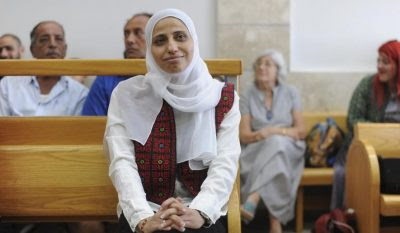
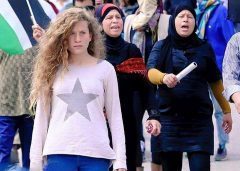
Esther Koontz (left) and Ahed Tamimi (right)
Earlier this year, Esther Koontz, a Mennonite school teacher, filed a lawsuit against the State of Kansas when she lost a job opportunity because she would not promise to not boycott Israeli corporations or institutions that participate in the oppression of Palestinian people. Esther told MennoPIN that after the injunction against the Kansas law took effect, “the state of Kansas passed a new law stating that the anti boycott certificate only applies to companies (not individuals) and only those with contracts over $100,000. Therefore, the law no longer applies to me, so I can no longer be a plaintiff. My lawyers will likely be dismissing the case on our terms.” Stay tuned for further developments on Esther’s case.
Also, a parole board in the West Bank Rimonim prison rejected Ahed Tamimi’s request for early release from prison because she has “dangerous ideology” and should remain in prison for deterrence purposes. The teenaged Ahed was sentenced to eight months in prison last March after confronting and slapping Israeli soldiers who shot here cousin in the face. After serving her full term, Ahed is set to be released from prison later this summer. During her parole session, Ahed told the parole board, “I will get out of prison with my head up.”
Congressional Bill to Apply Israel-Centric Definition to Antisemitism to Campuses
US lawmakers from both houses of Congress and both sides of the aisle have introduced legislation to make criticism of Israel on campuses and at other educational institutions equivalent to antisemitism. The current legislation (H.R.6421 and S.2940) is entitled: “Antisemitism Awareness Act of 2018.” While antisemitism is clearly on the rise in the United States and needs to be addressed and condemned, this bill effectively outlaws expression of a political and moral opinion critical of policies and actions by the government of Israel as antisemitic and illegal. Some states are also crafting similar legislation. MennoPIN encourages you to contact your congresspeople to express opposition to these bills.
Cities for Palestine Campaign and Toolkit
The US Campaign for Palestinian Rights has launched a new campaign called Cities for Palestine. Palestinians in the West Bank (including East Jerusalem) and the Gaza Strip are beginning their 51st year of brutal Israeli military occupation. As resistance builds across Palestine, the US Campaign is encouraging people in the United States to seize opportunities to organize for Palestinian rights in our cities, towns, counties and states. The municipalities approach has worked before, in the South African anti-apartheid movement and environmental justice campaigns.
Go here citiesforpalestine.org to get eight ideas on how to start a campaign and a toolkit to help implementing a municipal campaign in your community.
MCC Signs Ecumenical Gaza Refugee Rights Statement and Offers Actions to Take
The Mennonite Central Committee (MCC) sign a statement along with fourteen other church and church agency bodies in support of the right of return for the people of Gaza. Referring to the Great Return March, the statement affirms that “the Gaza demonstrations are an assertion of Palestinian rights: the rights of refugees, the right to demonstrate peacefully against injustice, and the right to live in and with dignity, not under closed military confinement or blockade.” Read the entire statement here.
The MCC Washington Memo also offers “Take Action” ideas to “Tell Congress: 70 Years of Suffering is Enough.” Go here and tell your congresspeople what you think!
Christ at the Checkpoint Conference USA
The first Christ at the Checkpoint Conference in the United States will be held in Oklahoma City, OK October 15 – 18, 2018. Since 2010 Palestinian Christians have held an international Christ at the Checkpoint Conference at Bethlehem Bible College in Bethlehem, Palestine every other year. Organizers of the U.S. conference feel “compelled to address the injustices that have taken place in the ongoing conflict between Israel and Palestine, particularly the Palestine lands under occupation…We believe that standing up nonviolently to injustice is an acceptable expression of our faith.” For more on the conference and to register, click here.
Support Palestinian Human Rights and Go HP-Free
Reach out to your pastor, church council and congregation to encourage your church to sign the HP Free Church pledge, committing to not buy HP computers, printers, inks, and other products until HP stops profiting from occupation and human rights violations. For more on the HP-Free Church Campaign go here.
Read More
Why Palestine Matters
No Way to Treat a Child Campaign
The Palestinian Portal Resource
HP-Free Church Campaign
Prayer
The “Great March of Return” continues in Gaza. Tens of thousands of Palestinians attended morning prayers for Eid-el-Fitr, the celebration which marks the end of the month-long Ramadan fast. Lord we continue to pray for the Palestinian demonstrators and their commitment to non-violence. We pray that the Israeli government would abide by international law and would allow Palestinian refugees to return to their homeland. Lord in you mercy…Hear our prayer. Sabeel wave of prayer
MennoPIN May 2018 Monthly Update
|
|||||||||||||||||||||||||||||
|
|||||||||||||||||||||||||||||
|
|||||||||||||||||||||||||||||
|
MennoPIN April 2018 Monthly Update
45 Palestinians Killed in the Great Return March
Nabi Saleh Remains Under Siege
Students for Justice in Palestine Activism Grows
Dangerous Exchanges in Durham, NC
MennoPIN Signs Letter Calling for End to the Occupation
Take A Palestinian Liberation Theology Short Course
Go HP-Free
Read More
Prayer

Transporting a wounded Palestinian demonstrator at the Great Return March. (Credit Mohammed Saber/European Pressphoto Agency)
As the Great Return March enters its fifth week, 45 Palestinians have been killed while thousands more have been injured. The nonviolent demonstrations, at the border between Israel and Gaza, began on Land Day, March 30, 2018 with protests against Israel’s refusal to allow refugees the right of return to their lands guaranteed by international law. The march will end on May 15, 2018, Nakba Day. Known as the “day of catastrophe” among Palestinians, Nakba Day this year marks the time seventy years ago when Israel became a state and violently drove hundreds of thousands of Palestinians into exile and killed thousands more. The demonstrations are expected to spread throughout Palestine on Nakba Day.Most Western media coverage of the Great Return March concentrates its attention on the few who have thrown rocks or rolled burning tires. Hamas is often portrayed as instigators of the demonstrations. Nothing could be further from the truth. The protests are intentionally nonviolent, and organizers of the march come from all segments of Gaza’s civil and political society, of which Hamas is one part, but only one player. It is the Israeli military forces, sheltered safely hundreds of meters away, who commit the violence, using sniper fire, teargas and grenades.Despite the continuing suffering, the spirit of Palestinian people remains strong and determined and the role of women at the forefront of peaceful protest is growing. Make sure that your congressional representatives know that you stand for peace with justice in Palestine.
Nabi Saleh Experiences Ongoing Siege
While 17-year-old Ahed Tamimi and her mother remain in prison, their village of Nabi Saleh remains under siege. For the last nine years, many of the village’s 600 inhabitants stage a weekly nonviolent protest following the Israeli confiscation of the main spring of the village for use by the Halamish settlement nearby. Israeli military forces respond to the peaceful demonstrators with teargas, arrests and sometimes bullets. Three people have been killed there and nineteen residents of Nabi Saleh are in prison.

Israeli soldiers shooting teargas in the center of the village of Nabi Saleh (Photo: Activetills.org)
Recent visitors describe their experience. A quiet Saturday in Nabi Saleh was broken by couple of booms: “Live gunfire followed by a stun grenade. Finally, a couple of minutes later we see teargas coming. In seconds, we were gagging, spitting up, coughing, tearing up—eyes on fire, throats chocking.”
Nabi Saleh is not alone in experiencing the Israeli occupation’s persistent violence against Palestinian villages in the West Bank. Many others also know similar unprovoked violence of Israel’s military forces.
Students for Justice in Palestine Activism Grows
Established in 2010, the Students for Justice in Palestine (SJP) has grown to more than 200 university chapters nationwide. Centering on freedom, justice and equality for the Palestinian people, SJP activists seek to educate and raise awareness among fellow students about the oppression experienced by Palestinians under the Israeli occupation, especially most recently in response to the killing of Palestinians in the Great Return March. But they also seek to pressure their respective universities to “divest its stocks, funds and endowment from companies that profit from the state of Israel’s violations of international law and Palestinian human rights through its ongoing system of settler colonialism, military occupation and apartheid,” as the Barnard College SJP chapter recently put it.
Barnard became the latest student body to approve a referendum, pressuring its administration to divest, with 64% of students in favor. More than sixty university student bodies have approved similar referendums and specifically name offending companies like Hewlett Packard, Caterpillar, GS4, Lockheed, Boeing and Elbit Systems. SJP works further to get their university to also approve of the measure.
Dangerous Exchanges and Durham, NC
Collaboration between the Trump and Netanyahu administrations has gone beyond embassy relocation and taken a deadly turn. The dangerous exchange programs bring together police, ICE, border patrol and the FBI from the United States with soldiers, police and border patrols from Israel for training in control, intimidation and the use of lethal force. In these mutual exchanges, the two countries learn from each other to promote discriminatory and repressive policies in both countries, including extrajudicial executions, shoot-to-kill policies, racial profiling, spying and surveillance, deportation and detention, and attacks on human rights defenders.
A coalition of racial justice and Palestinian solidarity activists in Durham, North Carolina set out to oppose these deadly exchanges between the Durham police force and agents of the Israel Defense Forces (IDF). Opposition included an interfaith petition to end the exchanges, calling on the city council to cut any police partnership with Israel. The petition was signed by 72 clergy from Jewish, Christian and Muslim traditions. On April 17, 2018 the Durham City Council unanimously passed a resolution to oppose international military-style police training. Hopefully, the Durham City Council will not be pressured into rescinding this resolution like the New Orleans City Council did in repealing a divestment resolution it passed, also unanimously.
Does your city have a dangerous exchange? Do you want to organize opposition? Contact MennoPIN for more information at mennopin@gmail.com.
MennoPIN Signs Letter Urging End to the Occupation
MennoPIN has endorsed a letter calling for Palestinian Christians and Muslims to help end the occupation. Signed by 14 groups supporting Palestinian human rights, the letter expresses “deep concern at the increasingly hostile direction of Israeli policies and actions, emboldened by the equally aggressive foreign policy stance of the Trump administration toward the Palestinian people.” To see the entire letter and endorsers, click here.
Take A Short Course in Palestinian Liberation Theology
Join Naim Ateek for a short course in Palestinian Liberation Theology, in person or by live streaming. Ateek is the co-founder of Palestinian Liberation Theology and has been inspiring readers with his ideas about faith, justice and the Holy Land for many years. For more information and to sign up, click here.
MennoPIN encourages you to join Eugene Mennonite Church, Eugene, OR and Peace Mennonite Fellowship, Claremont, CA and become HP-Free. Reach out to your pastor, church council and congregation to sign the HP-Free Church pledge, committing to not purchase Hewlett Packard computers, printers, inks, and other products until HP stops profiting from occupation and human rights violations. For more on the HP-Free Church Campaign go here.Read More
Students for Justice and Peace
Dangerous Exchanges
No Way to Treat a Child Campaign
The Palestinian Portal Resource
HP-Free Church CampaignPrayer
On the fourth Friday of popular protests in Gaza, Israeli forces killed four Palestinians. One of those killed was Mohammed Ayoub, a fifteen-year-old boy who was shot in the head by an Israeli sniper. This incident was caught on film The UN Middle East Envoy, Nickolay Mladenov, express his anger over the killing of the teenager and the European Union has demanded a full investigation into his death. Lord, we give thanks for the non-violent protests which continue to challenge the siege conditions suffered by those living in Gaza. We pray for those who take a stand for justice and raise their voices in protest against the oppression they experience. We pray for an end to the occupation and the liberation of the Palestinian people. Lord, in our mercy…
Sabeel Wave of Prayer, April 26, 2018
—
Mennonite Palestine-Israel Network
mennopin@gmail.com | mennopin.org | facebook.com/mennopin | twitter.com/mennopin
Steering Committee:
Tom Harder (Lorraine Avenue Mennonite Church, Wichita, KS)
Joy Lapp (Pleasant View Mennonite Church, Mt Pleasant, IA)
Jonathan Kuttab (Palestinian lawyer and human rights activist)
Anita Rediger (Emmaus Road Mennonite Fellowship, Berne, IN)
Joe Roos (Peace Mennonite Fellowship, Claremont, CA)
Rod Stafford (Portland Mennonite Church, OR)
MennoPIN Monthly Update March 2018
|
|||
|