Centering Palestine at MennoCon 2025
by Bob Atchison, MennoPIN Steering Committee Chair
July’s MennoCon 2025 in Greensboro, NC (Mennonite Church USA’s biennial convention) offered more seminars addressing peace and justice in Palestine and Israel than any other national convention I’ve attended. No doubt the genocide of Gaza had our attention, but at least nine sessions, maybe more, provided information on a range of topics from Christian Zionism and Nationalism to Antisemitism.
Amy Yoder McGloughlin’s Looking at Scripture Through the Lens of Land was the first seminar I attended. Amy invited us to consider how the locations of biblical storytelling matters and what their connections are to other stories that occurred previously on the same land. Jericho was one example, where the walls came down for both Joshua and Zacchaeus, just in very different ways. Amy also pointed out that indigenous story telling always makes land a character in the story adding another dimension.
Jonathan Brenneman and Drew Strait presented on White Christian Nationalism and Christian Zionism. Sponsored by AMBS and Mennonite Action, the seminar began by naming the 22 months of genocide that had occurred in Gaza and how the United States has spent 18 billion of our 2025 tax dollars on the war. According to Jonathan, 70% of the bombs dropped on Gaza were made in the US. Drew spoke of the dangers of Replacement Theory, which often fuels Christian Nationalism. Drew also provided a great list of books on how to address Christian Nationalism including his own Strange Worship: Six Steps for Challenging Christian Zionism, which I have found very helpful in taking direct oppositional action.

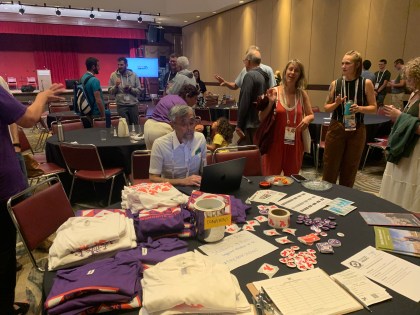
Nick Martin and Reah Clymer from Mennonite Action presented Stories from a Mennonite Social Movement describing the origin stories of Mennonite Action, the strong role of young Mennonites, and how they have become the leaders of this movement.
Hats off to Johnny Rashid and Erica Lea Simka for taking on the challenging presentation, Palestinian Justice and Resisting Antisemitism. Johnny did a good job reviewing Mennonites complicity in the Holocaust which has been presented at previous MennoCons and Erica tried to help us understand the nuances of taking Israel to task for genocide without engaging in antisemitic behavior. There were some heated discussions following this seminar.
Jonathan Kuttab, provided A Faithful Response to Palestine and Israel, calling us to action to respond to the violence and genocide in Gaza. Jonathan called us to faithfully witness and provided information on the apartheid systems and human rights violations Palestinians experience in their daily lives. At one point a young woman broke into tears asking, “but what can I do to make a difference?” Thank God for FOSNA, Mennonite Action, and so many organizations that continue to answer that question.
There were several other presentations worthy of describing but are beyond the scope of this newsletter. The only regret I have about MennoCon 2025 is not inviting Leila, from the Women in Hebron Cooperative, to speak at our MennoPIN/Mennonite Action Reception! The Women in Hebron sold a variety of Palestinian crafts at their booth. Our family came home with a beautifully embroidered Palestinian pillow. The good news is that Leila will be in the US through February and is available to visit congregations to talk about Palestine, and even provide a Palestinian meal! If this is of interest, please contact Amy Yoder McGloughlin at amy.yoder.mcgloughlin@gmail.com

Bob Atchison and Alex Awad at MennoPIN and Mennonite Action’s shared booth

As mass starvation stalks Gaza, aid groups plead for access
by Mennonite Central Committee as published in Anabaptist World

As the Israeli government’s siege starves the people of Gaza, aid workers are now joining the same food lines, risking being shot just to feed their families. With supplies now totally depleted, humanitarian organizations are witnessing their own colleagues and partners waste away before their eyes.
As the Israeli government’s siege starves the people of Gaza, aid workers are now joining the same food lines, risking being shot just to feed their families. With supplies now totally depleted, humanitarian organizations are witnessing their own colleagues and partners waste away before their eyes. Exactly two months since the Israeli government-controlled scheme, the Gaza Humanitarian Foundation, began operating, more than 100 organizations are sounding the alarm, urging governments to act: open all land crossings; restore the full flow of food, clean water, medical supplies, shelter items and fuel through a principled, United Nations-led mechanism; end the siege and agree to a ceasefire now.
“Each morning, the same question echoes across Gaza: Will I eat today?” said one agency representative.


The Task Ahead
by Jonathan Kuttub
It is quite clear that significant numbers of organizations and individuals all over the world are truly committed to justice in Palestine. From them I hear much genuine yearning for a just peace, as well as outrage at the ongoing genocide. I hear the clear condemnation of Zionism and of the state of Israel, but I rarely hear any antisemitism or hatred towards Jews. In fact some of the most cogent and principled critiques come from Jews, precisely because they see in the policies of the state of Israel a betrayal of their Jewish values and beliefs.
The real task before us is to translate this worldwide outpouring of support for Palestine into concrete actions to alleviate suffering and bring about steps towards a genuine just peace and end to hostilities. The best opportunity for that may be working for compliance with international law and universal principles of human rights, equality and self determination, rather than resorting to power, force and violence.
It is not true that international law does not have mechanisms for enforcement. What is true is that national governments are not willing to employ these mechanisms when it comes to the state of Israel. The crimes against humanity, war crimes, the crime of apartheid and of genocide all carry universal jurisdiction, which means individual countries can try these criminals in their own national courts. Furthermore, individual states who signed the different conventions are required to “ensure compliance” with the provisions of the various treaties and agreements, even when the UN Security Council (hampered by the U.S. veto) fails to act or where international tribunals like the ICJ and the ICC are too slow and timid to prosecute the criminals.
When states fail to act, it becomes the task of ordinary citizens and of civil society to pressure their own governments to act and to carry out their own nonviolent actions in that direction.


The genocide in Gaza continues and authoritarianism is on the rise across the U.S. As these two crises escalate, people of faith are in need of training, tools and frameworks to help us respond to, navigate, and rise to meet this tenuous political moment.
How do we continue to demonstrate for people in Gaza and respond to the growing threat that ICE represents in our communities? What tactics and strategies are most effective in this moment, and how can we draw upon our faith to find the courage to act in an increasingly frightening time?
Mennonite Action invites you to join a 4-week online organizing training series called Fall Term Courage School beginning in early September.
The goal of this training series is to provide Mennonite Action participants with the analysis, courage and concrete skills you need to meet this moment.
Mennonite Palestine Israel Network
MennoPIN keeps you informed about Palestine/Israel through our monthly update, special alerts, calls to action, important resources and tour possibilities, all from an Anabaptist perspective. To find out more, please visit our website at www.mennopin.org
Feedback, responses, and suggestions for future updates can be submitted to info@mennopin.org
Steering Committee
Bob Atchison (Manhattan Mennonite Church, Manhattan, KS)
Lydia Brenneman (Lima Mennonite Church, Lima, OH)
Dave Janzen (Fellowship of Hope, Elkhart, IN)
Michael George (Landisville Mennonite Church, PA)
Jonathan Kuttab (Palestinian lawyer and human rights activist, Manheim, PA)
Dorothy Jean Weaver (Community Mennonite Church, Harrisonburg, VA)
Zachary Murray (Mennonite Central Committee, Washington, DC)
Adam Ramer (Co-coordinator of Mennonite Action, New York, NY)
David Bluford (Rainbow Mennonite Church, Kansas City, KS)
Gretchen M (Philadelphia, PA)

 MennoPIN