In This Issue
Seeking MennoPIN Communications Coordinator
Resilience and Hope
A Poem: Gate A-4
Mennonite Action July Mobilizations
Prayers from Sabeel
Stay Informed on Palestine
Seeking MennoPIN Communications Coordinator

Are you looking for a way to help Palestine? Do you have 3 to 4 hours to spare once a month? Are you technologically competent and/or teachable?
If so, you may be a really great fit for the Communications Coordinator role with MennoPIN! My name is Lydia, and I started volunteering in this role last fall. Even though I didn’t have any communications experience, I was able to learn MailChimp and WordPress pretty quickly and was really grateful to have a concrete way to help out on a regular basis. It’s been wonderful getting to know the wonderful MennoPIN steering committee members and seeing more up-close the amazing work they’re doing as I put together the newsletter each month. I’m leaving the role next month so I’m looking for a replacement. Please reach out if you have any interest at all, and I can tell you more about the role.
And feel free to pass this on if you think someone else might be a good fit!
Contact Lydia Miller at lydia.miller28@gmail.com or text or call (607) 280-9471
Resilience and Hope
I should be in Palestine right now. The plan was to spend ten days there in August, visiting friends, and doing field research for a book I’m writing. But four days before the trip was scheduled to begin, Israel killed a Hezbollah leader in a targeted attack in Beirut, and also killed the leader of Hamas who was visiting Iran.
The drumbeats of a regional war grew louder. As I tried to discern next steps for my trip, the airlines canceled all flights into the region.
Deflated, I reached out to friends in the West Bank to cancel our plans, and as I did, I received updates on how they were doing. Islam, who lives in Jerusalem (but on the “wrong” side of the wall) reported that the Israeli military had demolished the home her father, an absolute genius with stonework, had been building for the two oldest sons in the family. She also sent me a video of a missile strike that narrowly missed her home the night before. She’s scared and angry.

Ali, Sami and Tariq, residents of the South Hebron Hills, reported settler attacks in each of their communities. These attacks resulted in water supplies cut off in Tariq’s community, attacks on sheep herders in Sami’s village, and an attempt by settlers to steal sheep on Ali’s village which resulted in his injury.
Hamed told me that even though money in the West Bank is very tight, because few are able to work, he’s still trying to get money together to send food to Gaza. He was happy to have found a restaurant that could somehow get meals into Gaza, and had fed several families.
My friends at Community Peacemaker Teams in Hebron told me that many of the shopkeepers I loved to visit have left the old city. It’s too dangerous to open their shops, because soldiers patrol the streets, and if there is anything in the shop that resembles the Palestinian flag, the shop can be trashed or the shopkeeper threatened.
All of my friends in the West Bank, despite their difficult circumstances, are safer than Gazans. Gaza continues to be bombed, the people continue to starve, and the death toll rises.
I don’t know anyone in Gaza, but because I know Islam, Ali, Sami, Tariq and Hamed in the West Bank, it makes what is happening in Gaza feel personal.
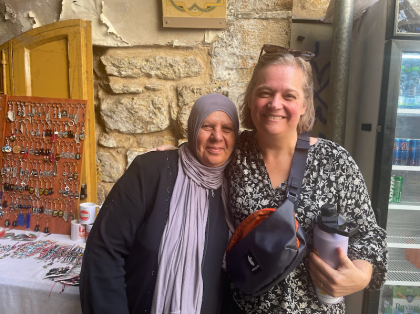
But Palestine is about more than just stories of death and woe. It’s about resilience and hope. I remember my visits with Munir, who makes me his signature tea for me. When I try to guess the secret ingredient, his eyes sparkle with joy and pride. I remember Abdullah, who has a quick, witty response to anything dense I could say about the occupation. I think of Mona, who likes to refer to me as “her favorite colonizer,” a sign that I have earned her respect, even though my country sends bombs that have been used on her people. I think of Laila, who has been known to chase soldiers out of her shop with her sharp tongue and fierce eyes. None of these friends have given up on their freedom, and neither can I. We continue to call on our legislators for a ceasefire because God’s beloveds in Israel and Palestine need to be free.
I hope to try to get back to Palestine next month, if a war can hold off. I miss my friends, and the way we can laugh, even when things are hard. I miss the land and the cool breeze that blows over the rocks when the sun sets. It’s those little moments in Palestine that give me hope–not all is lost. And one day, we will all be free.
Amy Yoder McGloughlin is the Conference Minister for Allegheny Mennonite Conference. She serves on the Steering Committee and Pastoral Team for Mennonite Action and the MennoPIN Christian Zionism Sub-Committee. She volunteers with Community Peacemaker Teams in the West Bank as much as she can.
Gate A-4
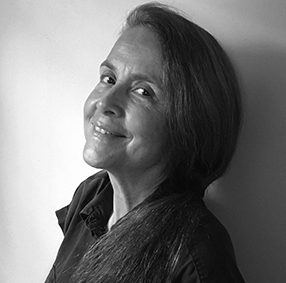
A photo of the poet. Credit to Michael Nye
Gate A-4, a Poem by Naomi Shihab Nye
Wandering around the Albuquerque Airport Terminal, after learning
my flight had been delayed four hours, I heard an announcement:
“If anyone in the vicinity of Gate A-4 understands any Arabic, please
come to the gate immediately.”
Well—one pauses these days. Gate A-4 was my own gate. I went there.
An older woman in full traditional Palestinian embroidered dress, just
like my grandma wore, was crumpled to the floor, wailing. “Help,”
said the flight agent. “Talk to her. What is her problem? We
told her the flight was going to be late and she did this.”
I stooped to put my arm around the woman and spoke haltingly.
“Shu-dow-a, Shu-bid-uck Habibti? Stani schway, Min fadlick, Shu-bit-
se-wee?” The minute she heard any words she knew, however poorly
used, she stopped crying. She thought the flight had been cancelled
entirely. She needed to be in El Paso for major medical treatment the
next day. I said, “No, we’re fine, you’ll get there, just later, who is
picking you up? Let’s call him.”
We called her son, I spoke with him in English. I told him I would
stay with his mother till we got on the plane and ride next to
her. She talked to him. Then we called her other sons just
for the fun of it. Then we called my dad and he and she spoke for a while
in Arabic and found out of course they had ten shared friends. Then I
thought just for the heck of it why not call some Palestinian poets I know
and let them chat with her? This all took up two hours.
She was laughing a lot by then. Telling of her life, patting my knee,
answering questions. She had pulled a sack of homemade mamool
cookies—little powdered sugar crumbly mounds stuffed with dates and
nuts—from her bag—and was offering them to all the women at the gate.
To my amazement, not a single woman declined one. It was like a
sacrament. The traveler from Argentina, the mom from California, the
lovely woman from Laredo—we were all covered with the same powdered
sugar. And smiling. There is no better cookie.
And then the airline broke out free apple juice from huge coolers and two
little girls from our flight ran around serving it and they
were covered with powdered sugar, too. And I noticed my new best friend—
by now we were holding hands—had a potted plant poking out of her bag,
some medicinal thing, with green furry leaves. Such an old country tradi-
tion. Always carry a plant. Always stay rooted to somewhere.
And I looked around that gate of late and weary ones and I thought, This
is the world I want to live in. The shared world. Not a single person in that
gate—once the crying of confusion stopped—seemed apprehensive about
any other person. They took the cookies. I wanted to hug all those other women, too.
This can still happen anywhere. Not everything is lost.
Mennonite Action’s July Mobilizations

Mennonite Action participants march accross a bridge holding signs and flags (photo credit to Rachel Schrock)
Reflection contributed by Adam Ramer, MennoPIN Board member and co-organizer of Mennonite Action.
In July, members of MennoPIN joined Mennonite Action on an ambitious goal — to march from Harrisonburg Virginia over 11 days and 135 miles and join an interfaith, multi-racial and intergenerational coalition, called “Interfaith Action for Palestine” to counter the large Christian Zionist organization, Christians United for Israel (CUFI) during its annual gathering. We also aimed to bring our message to Congress and President Joe Biden’s administration to support an immediate, permanent ceasefire, the release of all hostages and political prisoners, an end to military aid to Israel, and a political solution that ends the occupation of Palestine, ensuring peace for Palestinians and Israelis.
It felt important to join this coalition for a number of reasons, but maybe most importantly was the question “What more can I do for Gaza?” As a member of both MennoPIN’s board and a co-founder of Mennonite Action, I felt a responsibility to continue working for peace and justice, and the opportunity to join in a broader coalition with Jewish, Muslim, Christian, Hindu and Buddhist groups felt like a powerful choice.
On Thursday, July 18th the heatwave that engulfed much of the east coast for the previous subsided as the march began. That first day was mixed with emotions. Talking with marchers, a patchwork of sadness, nervousness, physical uncomfort, gratitude and determination brought the group together. On our first night we stayed at a local Mennonite church where we held a joint potluck with the Valley Muslim Community Foundation — a group that local Mennonites have been building community with for months in our work to pass Harrisonburg’s ceasefire resolution, along with other local coalition partners. Through interfaith prayers and gathering time we grounded our bodies and spirits for the days to come.
Each day we marched roughly 13 miles across varied terrain. We passed through the Blue Ridge Mountains, through fields and towns towards Washington DC. Each morning we read a land acknowledgment, and thought of our own complicity in settler colonialism in the United States/ Turtle Island while we also were marching for Palestine. As we marched, we sang hymns and shared poems and stories from Palestinine. The pain of blisters and aching knees accompanied us, and it guided us. We held signs and banners that read: ‘God Loves Every Child, No Exceptions’, ‘Send Food Not Bombs’, and ‘President Biden Open Your Eyes,’
Every step of our long journey to the DC our hearts were with the people of Gaza who have suffered so much from attacks with weapons of war supplied by our own government. We wanted our lawmakers to understand that our love must extend to all of God’s children, and that’s why we need a permanent ceasefire in Gaza now.
Once we arrived in DC, we marched directly to the White House for a service. For an hour, we held the space just north of the White House with prayer, song, and lamentation for those suffering in Gaza. And at the end of the service people were invited to write prayers and set them beside small tea candles in front of the White House.
Arriving in DC meant that we completed the first half of our mobilization and were ready for the second half: joining in with the interfaith coalition (Interfaith Action for Palestine) to counter the annual conference of Christians United For Israel (CUFI) and confront US lawmakers who are embracing CUFI’s agenda.
CUFI is an extreme Christian nationalist organization founded by far-right televangelist John Hagee, who is known for promoting extremist antisemitic tropes and Islamophobia. Mennonite Action and our interfaith allies wanted to demonstrate that this organization does not speak for all or most Christians and people of faith, and the goal was to ask lawmakers why they are aligning themselves with far-right extremists?
Interfaith Action for Palestine was made up of a number of convening organizations: Christians for a Free Palestine, Jewish Voice for Peace, Jewish Voice for Peace (DC), IfNotNow, Rabbis for Ceasefire, Muslim Alliance for Sexual and Gender Diversity, Hindus for Human Rights, Fellowship of Reconciliation and Mennonite Action. On top of these convening groups, numerous ecumenical groups, other Palestinian justice organizations and individual Synagogues and churches joined too. We wanted to show up as ourselves, from all of our faith backgrounds and show that faith voices won’t let far right Christian Zionism and Christian Nationalism speak for us.
We wanted to demonstrate this through direct action, interfaith prayer services, and our own lobbying efforts. And over a few days of programming, Mennonite Action and members of MennoPIN joined in a series of these actions across Washington DC. And much like Mennonite Action’s large action in January, we also had the opportunity to partake in Civil Disobedience. So on the afternoon of Tuesday, July 30th, a group of 50 of us walked into the large atrium of the Hart Senate building, sat down, and began singing hymns.
We wanted to disrupt business as usual for our elected officials who continue to prioritize death and destruction over a pathway to peace. We wanted our voices to echo out and show that we were saying no more, that we refused to be quiet in the face of injustice and that our faith demands us to call for peace and justice. And even as the plastic handcuffs were tightening around our wrists we kept singing. After a few hours in custody and paying a small fine, we were released and greeted with pizza and water, and lots of support from volunteers offering care.
The entirety of both the journey and the actions in DC felt immensely spiritual. It is easy to become numb and tired, especially after months of protests, meetings and prayers but where I find hope and purpose in the connections and relationships we forge along the way. During our time, I met some wonderful new people and connected with old acquaintances, and it is through those moments that I felt the most empowered.
Throughout our mobilizations I asked a lot of people the question: Why are you here? Why did you join? Specifics in the answers varied but there was a common thread: An unwavering commitment to peace, justice, and liberation for God’s beloved children.
It is because of those commitments why we must continue our work together.
And in the face of so much destruction that is being blindly supported by our government we must ask ourselves, How Can We Keep Silent?
Prayers from Sabeel
Last week, Israel arrested 30 Palestinians, including a female student, in its latest round of raids throughout the occupied West Bank, according to the Palestinian Prisoner’s Society. Most of those detained were taken from the Hebron governorate. Since October 7, Israel has made more than 10,100 arrests throughout the West Bank, holding many in administrative detention.
God of Justice, you know what it is like to be incarcerated under empire. You were with Joseph when he was imprisoned, and Your spirit visited Paul during his incarceration. Oh Holy Spirit, comfort the victims of cruelty and their families. Be with them in their moments of pain and anguish and kindle in them a light of hope. As we pray for those taken from their homes throughout Palestine, we remember the words of Isaiah 61:1: “The spirit of the Lord God is upon me, because the Lord has anointed me; he has sent me to bring good news to the oppressed, to bind up the brokenhearted, to proclaim liberty to the captives, and release to the prisoners.”
Lord in your mercy… hear our prayer.
Last week, which also marked the 75th year anniversary of the Geneva Conventions, U.S. Secretary of State Anthony Blinked approved a new batch of arms sales worth over $20 billion to Israel. This comes at a time of mounting criticism of the Biden administration and in the wake of reports of numerous Israeli violations of international law and human rights, including horrifying massacres of civilians on schools and camps in Gaza, torture of Palestinian detainees , and settler violence in the occupied West Bank.
O God of justice, we lift up the Palestinian people who endure unimaginable suffering—children in schools, families in camps, and detainees in prisons. As violence continues, fueled by the sale of arms and the silence of leaders, we pray for your intervention.
Grant justice where there is oppression, peace where there is violence, and strength to those who suffer. May the world awaken to their cries and act with righteousness.
Lord in your mercy… hear our prayer.
Stay Informed on Palestine
Organizations
- Mennonite Church Canada PIN
- Friends of Sabeel North America (FOSNA)
- Sabeel Ecumenical Liberation Theology Center
- Mennonite Central Committee Palestine and Israel
- Community Peacemaker Teams (CPT)
- U.S. Campaign for Palestine Rights (USCPR)
- Kairos Palestine
- Kairos USA
- Americans for Middle East Understanding (AMEU)
- Christian Zionism
- Palestinian Christian Alliance for Peace
- Palestine Portal
Web Publications
Mennonite Palestine-Israel Network
mennopin@gmail.com | mennopin.org | facebook.com/mennopin | twitter.com/mennopin
Steering Committee:
Bob Atchison (Manhattan Mennonite Church, Manhattan, KS)
Dorothy Jean Weaver (Community Mennonite Church, Harrisonburg, VA)
Dave Janzen (Fellowship of Hope, Elkhart, IN)
Jonathan Kuttab (Palestinian lawyer and human rights activist, Manheim, PA)
Lydia Brenneman (Lima Mennonite Church, Lima, OH)
Zachary Murray (Mennonite Central Committee, Washington, DC)
Lydia Miller (Kalamazoo Mennonite Fellowship, Kalamazoo MI)
Adam Ramer (Co-coordinator of Mennonite Action, New York, NY)

 MennoPIN